
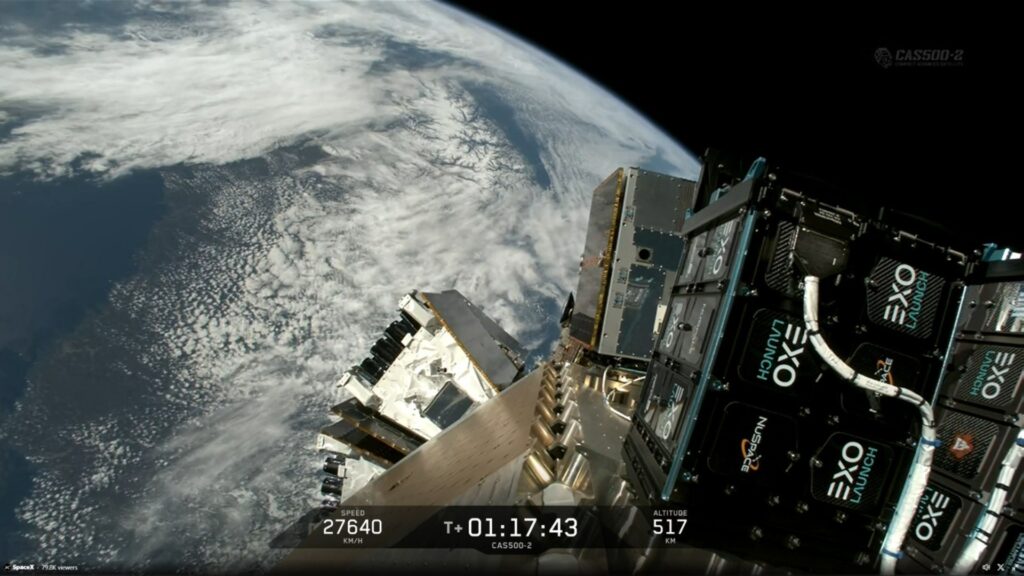
SINGAPORE — NuLink, NuSpace’s first commercial satellite network providing affordable and remote IoT connectivity in Southeast Asia, was successfully launched by SpaceX and deployed in orbit on 3 May 2026. Designed and built in Singapore with additive manufacturing, the NuLink antennae will begin receiving low-power signals from Earth as the satellite completes its Launch Early Orbit Phase. This milestone represents more than a successful deployment. It signals a new approach on how space hardware can be designed, produced, and scaled.
Rethinking Antennae Design for Space
Despite rapid advances in connectivity, more than 90 percent of the Earth’s surface remains underserved. Remote regions, oceans, and rural areas continue to lack reliable network coverage, limiting the reach of Internet of Things applications such as asset tracking and environmental monitoring.
Conventional satellite systems are typically designed for high-power, high-bandwidth applications. These systems are generally inefficient and costly, unsuitable for low-power wide-area connectivity. At the same time, traditional antenna design and manufacturing methods make it difficult to optimise performance, weight, and form factor for the implementation in small satellites.
Addressing this gap requires a fundamentally different approach.
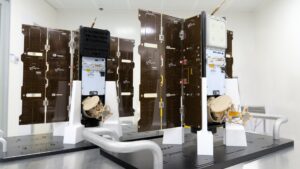
A project funded by the National Additive Manufacturing Innovation Cluster (NAMIC), coordinated by Additive Innovation Centre @ Agency for Science, Technology and Research (AIC @ A*STAR) brought together NuSpace, A*STAR Advanced Remanufacturing and Technology Centre (A*STAR ARTC), and the Institute for Infocomm Research (A*STAR I2R) to jointly develop a flight-ready antenna module for IoT satellite applications. The collaboration combines A*STAR I2R’s expertise in antenna engineering with A*STAR ARTC’s capabilities in advanced design and additive manufacturing. Working closely, the team refined the antenna design through multiple rounds of testing and simulation to ensure strong signal performance, structural reliability, and suitability for space deployment. The antenna was produced using additive manufacturing and a high performance, space-grade PEEK filament.
A Breakthrough Printed in Singapore
Using additive manufacturing, the team consolidated what would traditionally be an antenna assembled from 29 individual parts into 11 parts. This improved structural integrity while reducing potential points of failure, both critical factors in the harsh conditions of space. Additionally, additive manufacturing enabled approximately 300 percent cost savings, just on the parts.
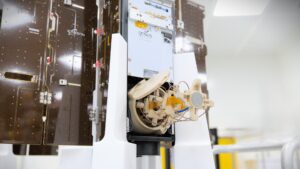
The design freedom offered by additive manufacturing also enabled more complex geometries that are not achievable through conventional methods. These enhancements translated into improved signal performance while maintaining strict constraints on size, weight and deployability.
Equally important was the speed of development. Rapid prototyping allowed the team to iterate and refine the design, accelerating the path from concept to flight-ready hardware from 3 months to under 6 weeks.
Unlocking NewSpace Opportunities
This antenna serves as a practical demonstration of how additive manufacturing can reshape the way space systems are built. By reducing material use, simplifying assembly, and shortening development cycles, it enables more agile and cost-effective satellite deployment.
“Additive manufacturing (AM) has materially changed how we produce components and compress lead times. Through this collaboration, we have seen firsthand that AM enables faster design iteration and unlocks geometries that traditional manufacturing simply cannot achieve. For antennae design specifically, that opens a solution space that was previously off the table. We see AM as a meaningful complement to our broader business strategy.”, said Ng Zhen Ning, CEO, NuSpace.
For Singapore, the achievement highlights the country’s capability in utilising advanced manufacturing techniques for emerging applications such as space. “NAMIC is delighted to be part of this endeavour with NuSpace and our sister research institutes. This project demonstrates the value proposition of additive manufacturing and its readiness for real-world mission-critical applications. As a global innovation hub, Singapore will continue to invest in scaling AM adoption through public-private partnerships to unlock new possibilities in industries, addressing increasingly complex product requirements and supply chain manufacturing lead-time challenges.”, said Dr Ho Chaw Sing, CEO, NAMIC.
The implications extend beyond the space sector. The same capabilities can be applied to industries such as aerospace, defence, and telecommunications, where high-performance, lightweight components are increasingly in demand.
This milestone reflects the strength of Singapore’s collaborative innovation ecosystem. By bringing together industry, research institutes, and public sector partners, initiatives like this are turning additive manufacturing into tangible outcomes. What begins in the lab is now reaching orbit, setting the stage for the next generation of space-ready technologies.
About the National Additive Manufacturing Innovation Cluster (NAMIC)
The National Additive Manufacturing Innovation Cluster (NAMIC) is Singapore’s national platform for accelerating the adoption of hybrid and digital additive manufacturing technologies. Hosted by the Agency for Science, Technology and Research (A*STAR) and supported by the National Research Foundation (NRF), NAMIC anchors Singapore as a global trusted node for resilient, sustainable, and smart manufacturing. Under the RIE2030 mandate, NAMIC drives transformative socioeconomic outcomes by fostering public-private partnerships and accelerating the commercial scale-up of industrial innovations. We envision the next generation of manufacturing as a seamless, data-driven ecosystem that integrates advanced materials, hybrid manufacturing, robotics, and artificial intelligence to create autonomous production workflows. To support this vision, we facilitate talent development and capability building in the field of additive manufacturing ensuring the workforce is equipped to lead and innovate. By bridging the gap between deep-tech R&D and industrial applications, NAMIC ensures Singapore remains a premier global hub for advanced manufacturing excellence. Learn more at https://namic.sg.
For media queries and clarifications, please contact:
Ms Michelle Ng
Marketing & Communications
National Additive Manufacturing Innovation Cluster (NAMIC)
michelle_ng [at] namic.sg