
AM Tech Insights: Two-Photon Polymerization – Enabling the Photonics and Microfabrication Revolution
The history of manufacturing has often been defined by our ability to create increasingly smaller, more complex, and more functional structures. Today, a new frontier is emerging at the intersection of additive manufacturing, photonics, biotechnology, microelectronics, and advanced medical devices: 3D printing. Among the technologies driving this transformation, Two-Photon Polymerization (2PP) has established itself as one of the most powerful tools for producing three-dimensional structures with sub-micron precision and unprecedented design freedom. UpNano has been at the forefront of this transition, developing manufacturing platforms capable of producing structures ranging from sub-micrometer dimensions to centimeter-scale components within a single system.
From Microns to Centimeters: A New Manufacturing Paradigm
Traditional manufacturing methods face significant challenges when producing highly complex structures at microscopic scales. Processes such as machining, molding, and lithography often require compromises between geometry, resolution, speed, and scalability. 2PP overcomes these limitations by using highly focused femtosecond laser pulses to selectively solidify photosensitive materials within a precisely defined volume.
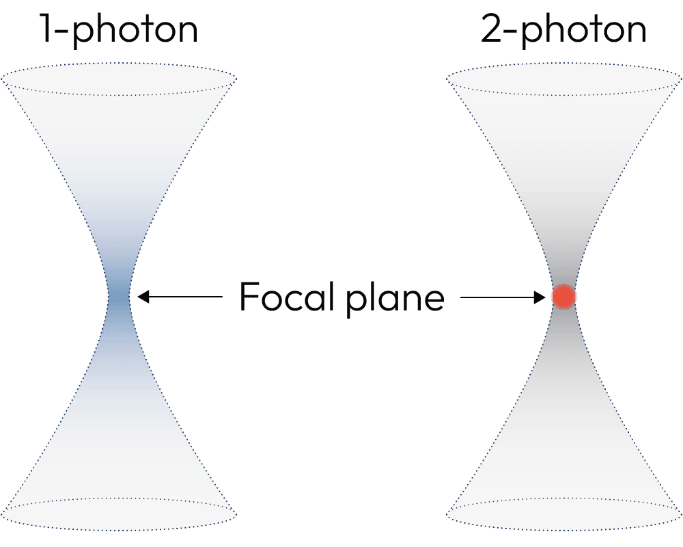
This capability allows engineers and researchers to create structures that were previously impossible to manufacture—from intricate micro-optics and photonic components to biomedical scaffolds, microfluidic systems, and advanced microelectromechanical devices.
Why 2PP Matters
Today, several global technology megatrends are accelerating demand for advanced microfabrication solutions. Artificial intelligence (AI), cloud computing, quantum technologies, optical communications, AR/VR systems, and advanced sensing platforms increasingly rely on highly sophisticated optical and photonic components. At the same time, healthcare innovations demand miniaturized devices capable of interacting with biological systems at cellular scales.
Photonics is rapidly becoming a foundational technology of the 21st century. Just as electronics powered the digital revolution of the last century, photonics is expected to drive future advances in communication, computing, sensing, healthcare, and defense. Optical microfabrication is among the fastest-growing segments within the photonics industry, fueled by increasing demand for photonic integrated circuits (PICs), LiDAR systems, quantum communication technologies, and next-generation imaging solutions. The ability to rapidly design, prototype, validate, and manufacture complex optical structures with sub-micron precision positions 2PP as a critical enabling technology for this emerging ecosystem.
Scaling Innovation Beyond the Laboratory
Historically, one of the primary challenges associated with high-resolution 3D printing has been balancing precision with productivity. Recent advances in hardware, software, and materials have significantly expanded the industrial viability of 2PP technology. This breakthrough enables organizations to transition seamlessly from research and prototyping to industrial production while maintaining exceptional accuracy and reproducibility. Applications now extend across multiple sectors:
- Micro-optics and photonics
- Biomedical devices and tissue engineering
- Microfluidics and lab-on-a-chip systems
- Microelectronics packaging and interconnects
- Advanced sensing technologies
As industries increasingly require customized, high-performance microparts, additive manufacturing at the microscale is moving from a research capability to a production necessity.
Driving the Future of Precision Manufacturing
The future of manufacturing will not simply be about producing larger volumes—it will be about producing smarter, more complex, and more functional components. Two-Photon Polymerization represents a fundamental shift in how engineers approach design and production at microscopic scales. By enabling unparalleled geometric freedom, sub-micron accuracy, and industrial scalability, 2PP 3D printing helps bridge the gap between scientific innovation and real-world manufacturing. The ability to manufacture complexity directly, rather than assembling it from simpler components, may ultimately become one of the defining capabilities of modern manufacturing – and UpNano is helping make that future possible.
Author: Denise Hirner, COO, UpNano GmbH
UpNano is a Vienna-based technology leader in Two-Photon Polymerization (2PP) 3D printing, providing high-performance microfabrication systems, optimized materials, and industrial production services.
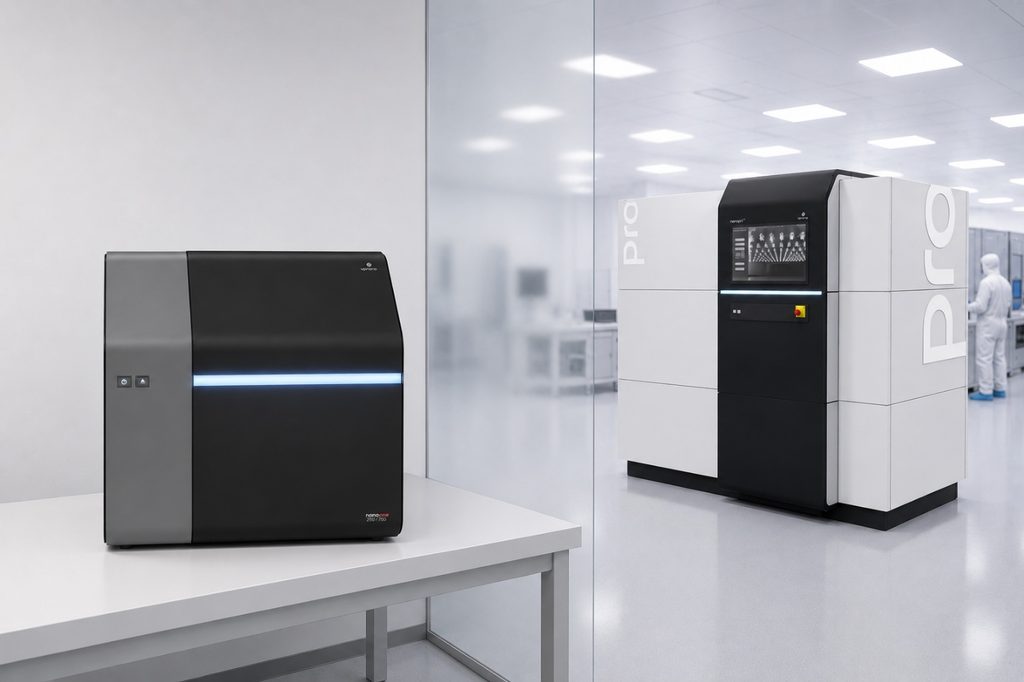
As demand for advanced photonics, microelectronics, and biomedical devices continues to grow, UpNano’s NanoOne platform and NanoPro printing service provide a seamless path from microfabrication innovation to industrial-scale production. © UpNano GmbH
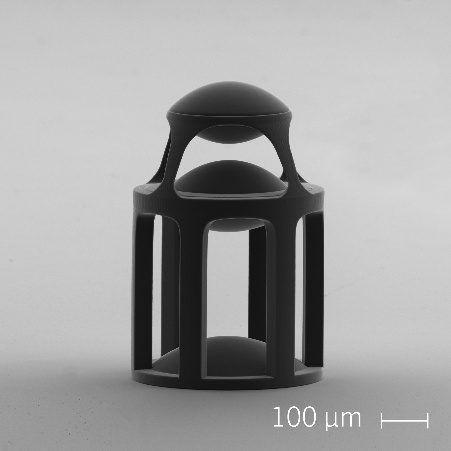
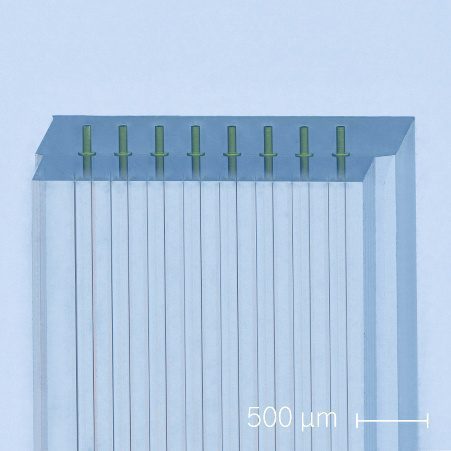
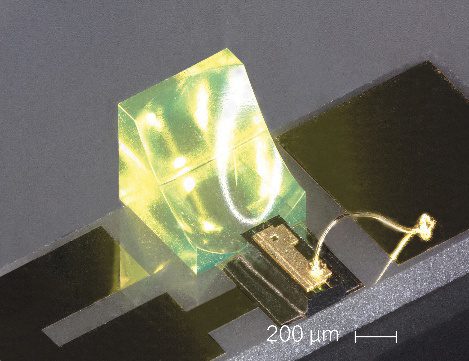
UpNano enables the fabrication of next-generation photonic and optical components with sub-micron precision. Shown from left to right are a parabolic mirror printed in front of an edge emitting quantum cascade laser QCL, a multi-fiber alignment structure for photonic packaging applications, and a stacked biconvex aspheric lens assembly illustrating the production of highly complex 3D micro-optics with ultra-low surface roughness and minimal shape deviation. © UpNano GmbH