
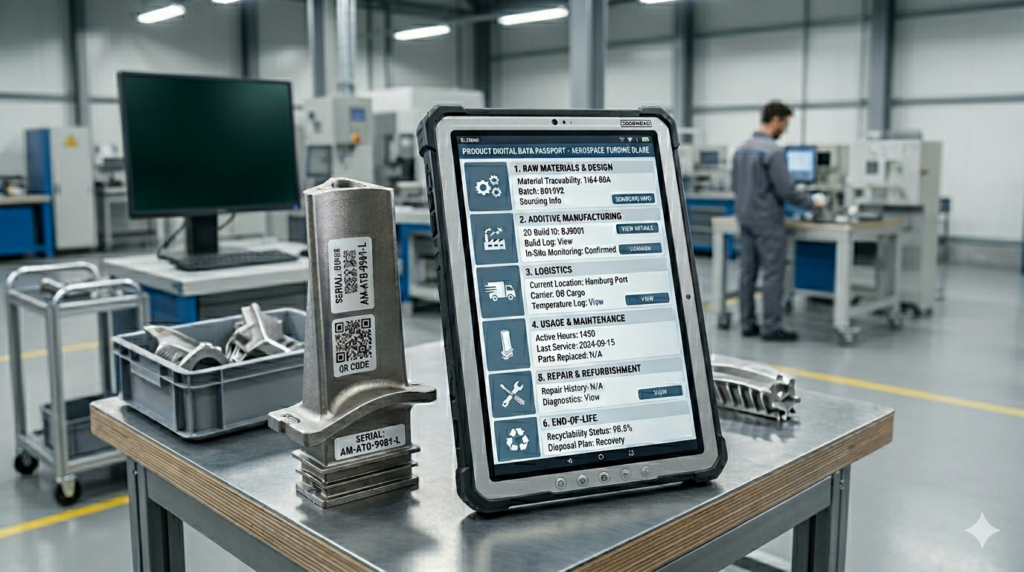
SINGAPORE – Additive manufacturing (AM) is moving rapidly from prototyping to production across industries such as aerospace, healthcare, and precision engineering. Yet, one fundamental challenge continues to limit its full-scale adoption: trust.
Fragmented data, inconsistent documentation, and complex certification requirements make it difficult for stakeholders to validate and scale AM parts with confidence. As supply chains become increasingly distributed, the need for a unified approach to digital traceability, interoperability and quality assurance has never been more critical.
A key solution gaining momentum is the concept of a digital passport for additively manufactured parts. This will be a structured, end-to-end digital record of a product lifecycle capturing data from design and materials to process parameters, post-processing, and inspection.
A National Effort to Build a Common Foundation
To address this need, a NAMIC-funded standards development project, led by the Additive Innovation Centre (AIC) and A*STAR Singapore Institute of Manufacturing Technology (A*STAR SIMTech), is working to establish a comprehensive framework model to document data for additively manufactured parts. The objective is clear: to define a structured and standardised approach for data documentation across the product lifecycle from start to end.
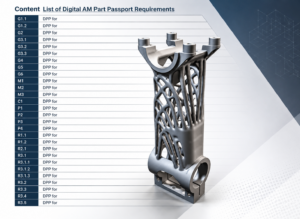
Today, AM adopters often operate with different data formats and processes, leading to duplicated qualification efforts and inefficiencies, particularly in regulated sectors.
The template under development will address these challenges by:
- Defining standardised data categories across the AM process cycle
- Enabling transparency and interoperability between machines, software, and stakeholders
- Providing a baseline template for companies to streamline the design-to-manufacture workflow
By doing so, it transforms fragmented data into a consistent and usable structure, making traceability and certification more efficient and reliable.
Why It Matters
This framework serves as a critical groundwork enabler for digital passports. It will lay the groundwork for implementation and broader industry adoption.
With a common structure in place, organisations can more easily implement digital systems or processes that consolidate and share trusted data across the value chain. For manufacturers, a common framework reduces time and cost associated with qualification and certification. For regulators, it provides greater consistency and transparency. For supply chains, it enables trusted collaboration across borders. This not only enhances transparency and repeatability but also strengthens confidence in AM parts, particularly in high-value and safety-critical applications.
Beyond quality assurance, digital passports also support lifecycle tracking, including maintenance, repair, and sustainability reporting which are key priorities as industries move towards greener manufacturing practices.
Ultimately, it allows AM to scale with confidence, shifting from isolated use cases to widespread industrial adoption.
A Stepping Stone to Standards
Importantly, this framework is a beginning to something bigger. This project brings together a working group of industry leaders, research institutions, and ecosystem partners as collaborators, which represents a first step in a broader standards development journey. The eventual goal is to push the framework aligned to Singapore standards and international standards.
The success of this initiative depends on active industry participation.
NAMIC and its partners invite stakeholders to contribute insights, validate approaches, and explore pilot implementations. By co-developing this framework, the industry can collectively shape a foundation that is practical, scalable, and globally relevant.
As additive manufacturing enters its next phase, trust will be the defining factor of its success, and a digital passport—enabled by a robust, standardised framework—offers a powerful pathway to achieve this.
If you are interested to be part of this, please email us at marketing[at]namic.sg.
About the National Additive Manufacturing Innovation Cluster (NAMIC)
The National Additive Manufacturing Innovation Cluster (NAMIC) is Singapore’s national platform for accelerating the adoption of hybrid and digital additive manufacturing technologies. Hosted by the Agency for Science, Technology and Research (A*STAR) and supported by the National Research Foundation (NRF), NAMIC anchors Singapore as a global trusted node for resilient, sustainable, and smart manufacturing. Under the RIE2030 mandate, NAMIC drives transformative socioeconomic outcomes by fostering public-private partnerships and accelerating the commercial scale-up of industrial innovations. We envision the next generation of manufacturing as a seamless, data-driven ecosystem that integrates advanced materials, hybrid manufacturing, robotics, and artificial intelligence to create autonomous production workflows. To support this vision, we facilitate talent development and capability building in the field of additive manufacturing ensuring the workforce is equipped to lead and innovate. By bridging the gap between deep-tech R&D and industrial applications, NAMIC ensures Singapore remains a premier global hub for advanced manufacturing excellence. Learn more at https://namic.sg.
For media queries and clarifications, please contact:
Ms Michelle Ng
Marketing & Communications
National Additive Manufacturing Innovation Cluster (NAMIC)
michelle_ng [at] namic.sg