
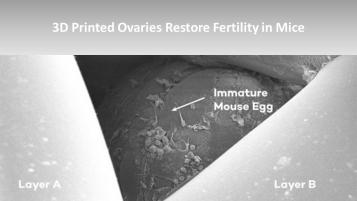
Prosthetic 3D-printed ovaries made of gelatin have allowed mice to conceive and give birth to healthy offspring. Such engineered ovaries could one day be used to help restore fertility in cancer survivors rendered sterile by radiation or chemotherapy. The researchers used a 3D printer with a nozzle that fired gelatin, derived from the collagen that’s naturally found in animal ovaries. The scientists built the ovaries by printing various patterns of overlapping gelatin filaments on glass slides—like building with Lincoln Logs, but on a miniature scale: Each scaffold measured just 15 by 15 mm. The team then carefully inserted mouse follicles—spherical structures containing a growing egg surrounded by hormone-producing cells—into these “scaffolds.” This “landmark study” is a “significant advance in the application of bioengineering to reproductive tissues,” says Mary Zelinski, a reproductive scientist at the Oregon National Primate Research Center in Beaverton who was not involved with the work. Source: Inside 3D Printing News
News
3D Printed Ovaries Restore Fertility in Mice
Cookie Consent
We use cookies to improve your experience on our site. By using our site, you consent to cookies.
Cookie Preferences
Manage your cookie preferences below:
Essential cookies enable basic functions and are necessary for the proper function of the website.
These cookies are needed for adding comments on this website.
Google reCAPTCHA helps protect websites from spam and abuse by verifying user interactions through challenges.
These cookies are used for managing login functionality on this website.
Statistics cookies collect information anonymously. This information helps us understand how visitors use our website.
Google Analytics is a powerful tool that tracks and analyzes website traffic for informed marketing decisions.
Service URL: policies.google.com (opens in a new window)